The End of An Era
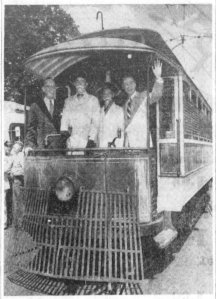
Four railway officials and employees are shown aboard the Green Line parlor car, “Kentucky,” which made it’s next to last run on July 1, 1950 during ceremonies celebrating the conversion of the Fort Mitchell line from streetcars to buses. Pictured are Morris Edwards President of the Cincinnati Street Railway and the American Transit Association; William Warton, operator of the Green Line, who retires today after 28 years of service; Charles Cummins of Covington and David L. Ringo, President of the Green Line. Credit: Cincinnati Enquirer
Until 1950, Northern Kentucky was home to a web of streetcar tracks and connections that served a wide swath of the river cities and beyond. The streetcars are our heritage. One could ride the rails and visit, commute, and do business in Bromley, Fort Mitchell, Fort Wright, Park Hills, Covington, Ludlow, Latonia, Newport, Southgate, Bellevue, Dayton, Fort Thomas, and yes, even Highland Heights. The system was tied to Cincinnati by three river crossings on the Roebling, Central, and L&N Bridges.
Northern Kentucky was home to a large share of the 222 miles of streetcar tracks in the region.1
But at 12:05 AM on Sunday, July 2, 1950, that legacy became part of our past. That’s when Elmer Denigan, guiding the Fort Mitchell “rattler”, reached the end of the line and then navigated the cars back home to the to the barn at 20th and Madison in Covington. The Cincinnati, Newport and Covington Railway yielded to the buses that replaced it with the promise of additional service and modern comforts.
A day and a half earlier, in an effort to foment enthusiasm for a motorized future, the soon-to-be-mothballed “Old Kentucky” from the Fort Mitchell line led a parade of the new modern buses across the Roebling and into Dixie Terminal. The condemned cornerstone of our connectivity was forced to parade it’s spiritless, expendable replacement around town for all to see. (more…)
 Northern Kentucky Streetcar